- Telegram:@dzsms777
- WhatsApp:+1(873)7774378
Industry News
How AI is redefining Chinese EVs--China Economic Net
Wang Kai
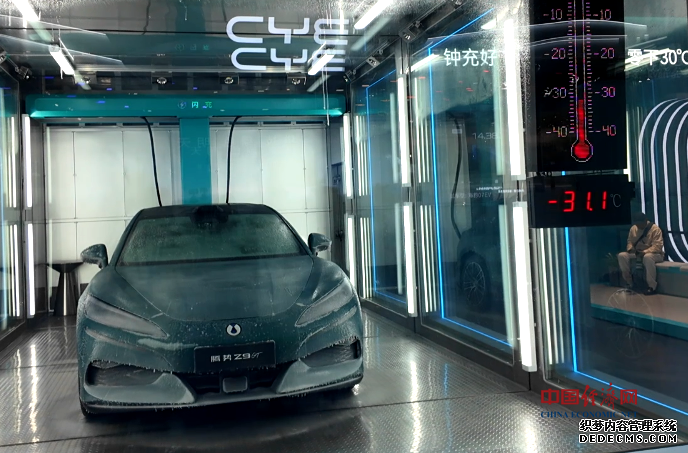
At the Beijing Auto Show, BYD showcased its ultra-fast charging technology, capable of charging a battery from 20% to 97% at –30°C in just three minutes longer than under normal conditions. [Pic/China Economic Net]
BEIJING, Apr 30 (China Economic Net) - From the world's first fully automotive-grade, fully redundant L4 autonomous light truck, to smart cockpits that can understand driver intent within 150 milliseconds and chat with users in different personalities, to the world's first 32Gbps in-vehicle SerDes display chip, to Blade batteries capable of charging from 10% to 97% in nine minutes...At the ongoing Beijing Auto Show, "intelligent cars" take center stage, with 181 vehicles debutting and 71 concept cars on display, showcasing how AI is transforming China's auto sector at a stunning pace.
Iyiou, a think tank, estimates that China's AI-powered EV market reached 4.363 million units in 2025, up 18.7% year-on-year. Penetration is projected to rise to 50% by 2030, with Vision-Language-Action (VLA) architectures and AI agents emerging as the core engines of growth.
Hands Off the Wheel
Compared with just two years ago, the cost of assisted-driving systems has fallen by 40% to 60%, turning what was once a luxury feature into a mass-market offering. According to the China Academy of Information and Communications Technology, more than 62% of new passenger cars sold in 2025 came equipped with Level 2 combined driver-assistance functions. In the sub-RMB200,000 segment, 4.24 million new passenger cars carried such systems, up 39.3% year on year. In the sub-RMB100,000 category, installations surged by an extraordinary 985%.
Industry observers increasingly describe 2026 as the first year of large-scale commercialisation for Level 3 autonomous driving—known as conditional automation, in which the vehicle can fully take control in defined scenarios such as highways or urban expressways. Within the next one to two years, urban Navigation on Autopilot features could also become available in vehicles priced from around RMB 100,000.
Several leading carmakers leveraged the Beijing Auto Show to demonstrate how rapidly hardware capabilities are advancing. Li Auto's new L9 Livis features four high-performance lidar sensors and two self-developed 5nm chips, delivering total computing power of 2,560 TOPS. NIO's ES9 is powered by in-house chips exceeding 1,000 TOPS, while XPeng's GX uses four proprietary Turing AI chips, providing 3,000 TOPS of effective local computing power.
Consumer expectations are evolving just as fast. Surveys by Autohome show that more than half of users in China now believe highway and urban-road assisted driving should be a basic feature, not an expensive add-on.
China has already opened legal Level 3 road sections across highways and expressways in 23 cities, supported by Vehicle-Road-Cloud (VRC) integration—a home-grown smart-mobility system linking vehicles, roadside sensors, 5G networks and cloud platforms for real-time data sharing, safer autonomous driving and more efficient traffic management. By 2027, digital upgrades are expected to cover 85% of busy highways and 25% of major national roads.
Battery technology is helping to accelerate the shift. China supplies around 70% of the world's battery materials and 60% of global power batteries. At the Beijing show, several automakers and battery developers unveiled new packs capable of driving ranges beyond 1,000km.
CALB introduced what it described as the world's first mass-produced aviation-grade semi-solid-state battery, with an energy density of 360Wh/kg. Li Yan, the firm's sales director for Europe's passenger-vehicle business, said China's battery industry benefits from an unusually resilient supply chain, spanning upstream raw materials through to highly specialised components and manufacturing equipment. "The industry has built a stable, multi-layered sourcing network, where the absence of a few suppliers will not impact the whole," she said.
Shi Jianhua, deputy secretary-general of ChinaEV100, a think tank, said sodium-ion batteries would serve as an important complement to existing technologies. Small-scale vehicle demonstrations could begin this year or next, with initial commercialisation by 2030 and larger-scale production within three to five years. Combined with continuing improvements in mature lithium iron phosphate batteries and advances in solid-state chemistry, he opined, multiple battery technologies will together provide the foundation for the next stage of electric-vehicle growth.
The Car That Knows You Best
Consumers are no longer satisfied with cars that merely contain features. They now want cars that can understand requests—and quietly get things done.
This month, Horizon Robotics unveiled two notable products: Horizon Starry Agentic Car SoC,China's first integrated cockpit-driving chip for whole vehicles, and KaKaClaw, China's first Agentic car operating system. Starry SoC replaces the traditional two-system architecture (intelligent driving and cockpit) with a single chip, significantly reducing hardware costs and development complexity.KaKaClaw promise a car that remembers preferred settings, daily routes, habits and even personality traits—then adjusts the cabin environment according to mood, all through natural conversation.
China's smart-cockpit installation rates have surpassed 76%, and Guohai Securities forecasts compound annual growth of more than 27% over the next five years. What was once a dashboard screen and instrument panel is expanding into a digital living room: head-up displays, passenger entertainment screens and rear-seat smart displays are becoming standard fare. Several autonomous-driving suppliers and carmakers have recently announced plans to accelerate mass adoption by slashing costs, pushing driver-assistance systems into the "thousand-yuan era".
China may hold an edge in the software layer. Neusoft, a technology provider, argues that China's cloud ecosystem outpaces overseas rivals, helped by world-leading 5G infrastructure and a richer pace of cloud innovation. The firm says cockpit voice interactions can now respond in 150 to 200 milliseconds—quick enough to feel instantaneous to human senses—and that such systems are already in mass production.
Yet speed alone is not enough. Shuai Bin, a postdoctoral researcher at Tsinghua University, notes that today's cars still behave as though "every ride is the first meeting", lacking memory and the ability to evolve with users over time. Li Jinlong, chairman of the management committee at AutoLink, puts it more bluntly: the true killer app is not any single feature, but a car that understands the driver before a word is spoken.
That vision may arrive sooner than expected. According to the white paper Smart Cockpits: Defining a New Automotive Paradigm in the AGI Era, on-device AI capabilities are likely to shift from premium differentiator to basic requirement within the next two to three years, powered by stronger automotive-grade chips, a shift toward centralised electronic architectures, and maturing collaboration between cloud and edge computing.
Beyond cars
Shi Jianhua points to a broader industrial convergence already underway. Automotive technology is increasingly merging with robotics, low-altitude aviation and other AI-driven systems. Roughly 70% of this foundation, he argues, is transferable to emerging "compound intelligence" industries such as robotics, drones and autonomous vessels. The modern intelligent vehicle, he notes, is no longer just a car, but an AI terminal on wheels—built on the integration of artificial intelligence, connectivity, batteries, power systems and new materials. It can drive multiple trillion-level industries, such as unmanned taxis, unmanned ride-hailing services, and unmanned logistics.
Pony.ai, a self-driving company, expects the total cost of its Robotaxi—including the vehicle and full sensor suite—to fall below 230,000 yuan. That places it in stark contrast to U.S. rival Waymo, whose autonomous vehicles reportedly cost around $200,000 each. On a like-for-like comparison, the Chinese system could be roughly six to seven times cheaper. The company attributes this advantage to its "single-vehicle intelligence" approach, which reduces reliance on expensive external infrastructure.
Another layer of transformation lies in the convergence of vehicles and energy systems. Shi points out the coordination between new energy vehicles and the power grid could generate "1+1>2" effects. By 2030, China's EV fleet could exceed 100 million units. The collective storage capacity of vehicle batteries alone could surpass 600 GWh, turning cars into a distributed energy buffer for the grid.
-
 'Factory Flower' is a robot 2026-10-26
 -
 How to win in "AI+"? The synergy of "green el 2026-10-26
 - Youthful Chapter Pursuing Dreams in Northern Xinjiang | Sing 2026-10-26
- Damai Performance hosts Xiao Zhan's tour in Nanjing, with st 2026-10-26
- China marks anniversary of Taiwan's recovery with events ac 2026-10-26