- Telegram:@dzsms777
- WhatsApp:+1(312)3712538
Industry News
Turning a Drainage Ditch into a $70,000 Cash Cow: How a Vill
by Wang Kai, Han Lu
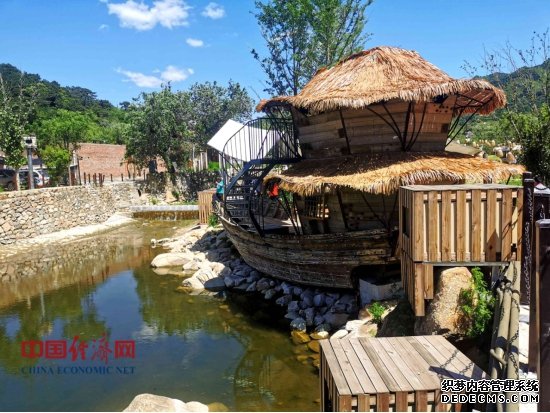
A ship-shaped coffee house at Nanshan Village, Pinggu District, Beijing [Photo/Wang Kai]
BEIJING, Jun 1 (China Economic Net) - In a village 91 kilometers from downtown Beijing, a once-forgotten hamlet surrounded by over 30,000 acres of peach blossoms is reinventing itself. Cafés, glasshouse lounges, book bars, farmers’ markets, and pet-themed playgrounds now line the village lanes.
Beside what was once little more than a drainage ditch, a retro-style coffee house is opening soon.
“In summer, it becomes a waterway; in winter, it turns into a light-show venue. This single site now generates over RMB 500,000 (about $70,000) annually for the village,” Li Na, a person in charge, told China Economic Net.
Just three years ago, fewer than one-third of the village’s homes were occupied. Most young people had left in search of work elsewhere. But over the past two years, the number of returnees has risen by 20 percent, as long-abandoned houses were renovated, rented out, and turned profitable.
The once-overlooked settlement has become a popular countryside retreat for urban white-collar workers seeking an escape from city life. Many come to admire the peach blossoms and nearby Jinhai Lake.
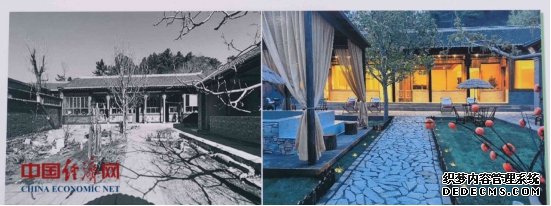
Nanshan Village, Pinggu District, Beijing: Past and present [Photo/Wang Kai]
“During this year’s May Day holiday alone, more than 5,000 visitors arrived each day in search of a slower pace of life,” according to Li. The village, home to just over 2,200 residents, now hosts 32 themed homestays. Depending on the season and holiday calendar, local organizers curate pet exhibitions, graffiti parties, mountain concerts, traditional wellness classes, agricultural fairs, and heritage health therapies to attract different groups of visitors.
“Household income used to be below RMB 100,000 a year. Now, rental income alone has increased that sixfold,” Li said. “E-commerce platforms have also boosted the local economy. Fresh produce, homestays, and recreational activities can now all reach urban consumers online.”
By the end of 2020, China had declared victory in its campaign to eradicate extreme poverty. Since then, the country’s anti-poverty focus has shifted toward preventing people from falling back into poverty and addressing relative deprivation. Health insurance coverage among formerly impoverished populations has remained above 99 percent, while rural tap-water access has reached 96 percent, according to data from the International Poverty Reduction Center in China (IPRCC).
In the 2026 “No. 1 Central Document” — the government’s most important annual rural policy directive — the country calls for the institutionalization of “regularized precision assistance”. Over the previous five years, more than seven million at-risk individuals received help to avoid falling back into poverty.
The Business of Beating Poverty
Yu Jinxiu once worked in Shanghai, earning a living through moxibustion, a form of traditional Chinese medicine therapy. Ten years ago, she returned to her hometown of Wudoudi Village and, with government support, established a vocational training school.
Today, the sector has grown into a RMB 19 billion industry. Wudoudi Village has transformed from being nearly RMB 2 million in debt into a community where annual per capita income exceeds RMB 20,000.
“Over the past decade, we’ve built more than 200 training centers nationwide and trained over 36,000 students,” Yu said. “We’re also seeing more international faces. Recently, I enrolled more than 40 students from Singapore, Malaysia, and other Southeast Asian countries.”
According to IPRCC, industrial assistance programs have covered 98.9 percent of once impoverished counties in China. All 832 counties officially lifted out of poverty have cultivated two to three pillar industries with strong growth potential. Between 2020 and 2025, disposable income for rural residents in those counties grew by an average of 8.2 percent annually in real terms — 0.8 percentage points higher than the national rural average.
Together, these industries now generate output worth more than RMB 1.7 trillion. Nearly three-quarters of formerly impoverished residents have established income-sharing links with modern agricultural enterprises or cooperatives.
“I find it useful to think of anti-poverty policy as having a demand side and a supply side,” said Renato Domith Godinho, Director of the Global Alliance Against Hunger and Poverty.
“The demand side fills an income gap directly through cash programs like China’s Dibao or Brazil’s Bolsa Família. The supply side is different. It does not transfer income. It builds the environment, the capacity, and the human and physical capital that allow people to play a productive role in the economy.”
“In cities, markets can do much of this work. But in rural areas, in remote villages, markets alone are not enough. The state has to provide the push. Where China is especially strong, in our view, is on the supply side,” he commented, pointing to industrial development reaching poor households, large-scale relocation from inhospitable areas, ecological compensation programs that turned poor farmers into forest rangers, and village-level coordination led by resident officials.
Can China’s Model Work Elsewhere?
Ihsaan Afzal Khan, Coordinator to Pakistani Prime Minister on Commerce, noted institutional features rarely found elsewhere: China’s five-tier system of government allows decisions to be made efficiently; extremely long-term planning ensures continuity through successive Five-Year Plans.
For countries without continuous governance bodies or funding, is it still feasible to gain any inspiration from China’s poverty reduction practices?
Li Xiaoyun, Chair Professor at China Agricultural University, argued that while China and other Global South countries differ institutionally and culturally, they share many structural realities.
“Most Global South countries face similar constraints: low levels of industrialization and urbanization, limited capital, weak technology, and imperfect markets,” he said. “What they often do possess are abundant labor and land resources. The challenge is finding effective pathways to transform those resources into development.”
He described China’s “development-oriented poverty alleviation” model as a pragmatic path defined by low thresholds, low costs, and high participation.
“The richest resource in many Global South countries is labor, while capital remains scarce,” Li said. “You cannot simply rely on borrowing and large-scale capital investment. What China can share are countless small but practical technologies and labor-intensive development approaches.”
Sabina Alkire noted that several aspects of China’s targeted poverty alleviation model have already proven adaptable abroad.
“When we developed a case study for our South-South network, we identified features that are highly transferable,” she said. “The multidimensional approach — ensuring food and clothing while guaranteeing healthcare, education, and housing — is extremely relevant.”
Another key feature, she said, is household-level measurement. “In Honduras during the pandemic, authorities worked with the UNDP to identify the specific deprivations faced by individual households and distributed QR-code vouchers for food and healthcare assistance,” she explained.
She also highlighted the role of grassroots poverty officers. “In Colombia, poverty fell by one-third over eight years. Around 10,000 social workers went door to door connecting poor families to services they didn’t know existed and helping them develop pathways out of poverty. When families exited poverty, there was even a small graduation ceremony.”
The clout is palpable.
In Tanzania, Li’s team introduced high-density corn planting techniques to villages in the Morogoro region more than a decade ago. Today, farmers see yields rise by 30 to 50 percent per acre.
“The technology is simple, low-cost, and easy to learn. In practical terms, a farmer simply needs to devote more labor and change planting methods without increasing financial input,” Li said.
Over the past five years, China trained more than 200,000 people from developing nations through capacity-building programs under the Global Development Initiative. Its hybrid rice has now spread to nearly 70 countries across five continents, helping raise rice yields in several African countries from roughly two tons per hectare to as high as 7.5 tons. Juncao grass technology has taken root in over 100 countries, creating hundreds of thousands of jobs. Laos, Cambodia, and Myanmar have adapted elements of China’s “whole-village advancement” and “targeted poverty alleviation” approaches with notable results.
-
 China's investment in real estate development down 20.6 pct 2026-10-19
 - China's surveyed urban unemployment rate falls to 5.2 pct i 2026-10-19
- China's retail sales of goods, services up 2.6 pct in first 2026-10-19
- China's GDP expands 4.5 pct year on year in Q3--China Econo 2026-10-19
- Knocking on the EU's Door with Gifts--China Economic Net 2026-10-19
Related Product
Related News

- 1600 Pennsylvania Ave NW,Washington,DC20500,USA
- Telegram: @dzsms777
- Tg Group: @dzsmsPD
- WhatsApp: +1(312)3712538
Contact Us
WhatsApp: +1(312)3712538