- Telegram:@dzsms777
- WhatsApp:+1(312)3712538
Industry News
Pakistan Launches Landmark Desert Horticulture Cooperation w
by Wang Kai
MULTAN, Jun 18 (China Economic Net) - Pakistan's first-ever Joint Laboratory for Desert Agriculture; and Science and Technology Backyard on Desert Horticulture were unveiled on Wednesday through an MOU to turn vast stretches of desert land of Pakistan into productive farmland.
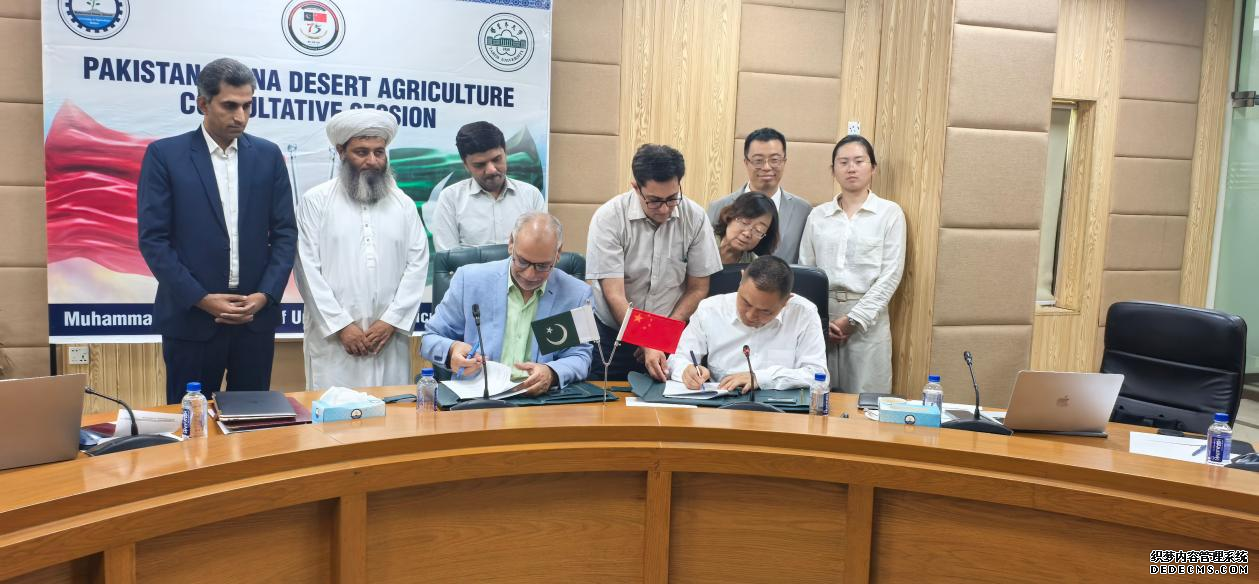
China's Tarim University in Xinjiang and Pakistan's Muhammad Nawaz Sharif University of Agriculture (MNSUA) in Multan signed MoU on desert horticulture cooperation on Jun 17, 2026. Photo provided to China Economic Net
Bringing together China's Tarim University in Xinjiang and Pakistan's Muhammad Nawaz Sharif University of Agriculture (MNSUA) in Multan, the partnership is expected to serve as a platform for technology transfer, scientific research, and farmer training focused on desert agriculture.
Dr. Abid Ali, chief scientist on Pakistani side, revealed the cooperation will focus on introducing a range of advanced technologies, including solar-powered greenhouse systems, precision agriculture, drone-based crop monitoring, and water-saving drip irrigation.
According to Dr. Ali, technologies developed by Tarim University could help address some of Pakistan's most pressing agricultural challenges, including water scarcity and low productivity in desert regions.
"The technologies have already proven successful in Xinjiang," Dr. Ali said. “For example, the low-cost, high-efficiency desert solar greenhouse technology addresses the longstanding challenge of low land utilization in traditional solar greenhouses, increasing land-use efficiency by up to 35%. Its simple modular assembly structure enables rapid construction while ensuring excellent daylighting and heat-retention performance with a construction cost of only about RMB 290–320 (PKR 11,000–12,500) per square meter.”
Complementing this system, the water-curtain floor heating technology, also known as plant root-zone warming technology, captures and stores solar heat energy during the day and gradually releases it at night. This improves the greenhouse microclimate, raises nighttime temperatures by approximately 5%, and significantly reduces overall energy consumption, enhancing both crop productivity and sustainability.
"Pakistan is an ideal first destination for its international application as the country has intensified efforts to reclaim arid areas through the Green Pakistan Initiative, which promotes modern farming technologies, drought-resistant crops, and sustainable land management,” he said.
Uncultivated desert land accounts for nearly 15% percent of Pakistan’s territory. Multan, as a major agricultural center in Pakistan and surrounded by deserts and CPEC roads, is set to benefit from new cultivation methods.
Dr. Ali described the project as a milestone not only for Pakistan but also for the wider region. “The initiative could provide a model for and be extended to other arid regions across Central Asia and the Middle East,” he said.
-
 Ningbo Smart Expo Showcases BRI Tech Collaboration in Action 2026-09-16
 - China to further boost tourism growth via better natural res 2026-09-16
- China ready to work with ASEAN for closer community with sha 2026-09-16
- China's non-bank cross-border receipts, payments maintain g 2026-09-16
- Music Bridges China-Pakistan Friendship as Diplomatic Ties 2026-09-16
Related Product
Related News

- 1600 Pennsylvania Ave NW,Washington,DC20500,USA
- Telegram: @dzsms777
- Tg Group: @dzsmsPD
- WhatsApp: +1(312)3712538
Contact Us
WhatsApp: +1(312)3712538