- Telegram:@dzsms777
- WhatsApp:+1(312)3712538
Latest Updates
China Pakistan cooperation drives Pakistan's energy self-re
by Wang Kai
"Pakistan-China cooperation in green energy is gaining momentum. We are working to establish South Asia's first electric taxi fleet in Islamabad, and we will sign an agreement with Beijing Automotive Group (BAIC) to enable more electric vehicles to be assembled in Pakistan," said Khalid Mahmood, former Secretary of Pakistan's Parliamentary Committee -CPEC and CEO of two privately owned car companies in Pakistan, in a recent interview with China Economic Net.
Pakistan is swiftly shift toward consumer-driven distributed renewable energy. With 38 GW of solar already installed across the country, rapidly growing battery adoption, and increasing EV uptake, Pakistan's power system is entering a new phase of electrification. According to Renewables First, a think tank, the country had avoided more than USD 12 billion in oil and gas imports by February this year that would otherwise have been needed to meet domestic energy demand. It estimates that at the prices the market expects for this year, Pakistan could save a further USD 6.3 billion by the end of the year.
This transition has been made possible through more than a decade of sustained investment, driven in large part by a market-led revolution enabled by Chinese manufacturing.
According to KTrade Securities, approximately 13 GW of power capacity were added through CPEC early cooperation projects. Prior to CPEC, Pakistan faced electricity shortfalls exceeding 4,500 MW, with blackouts lasting up to 18 hours per day in some areas - reducing estimated annual GDP by 2–2.5%. By December 2017, Pakistan achieved a surplus in electricity production for the first time.
Chinese FDI into Pakistan's power sector reached USD 1,165.7 million in FY 2024–25, including USD 759.4 million in hydroelectric projects alone reflecting a clear accelerating trend. Currently, 60 private-sector renewable projects under PPIB contribute 4,753 MW to the national grid.
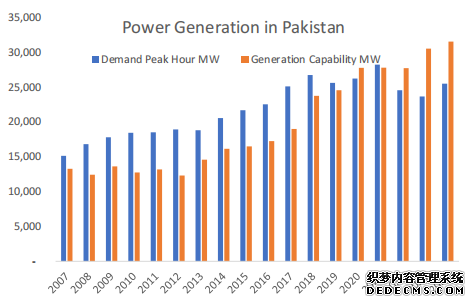
Graphic from KTrade Securities
Low Carbon Power statistics show that in 2025, Pakistan's electricity consumption is predominantly fueled by low-carbon sources, which account for over 64% of the total electricity generation.
Solar: From importer to manufacturer
Over the past five years, culminating in the data available for early 2026, Pakistan imported 50 gigawatts (GW) of Chinese solar panels. According to Illuminem, a sustainability information hub, this phenomenon, termed the "solar supernova" by energy analysts, was catalyzed by a collapse in module prices, which plummeted to historic lows of $0.07–$0.09 per watt.
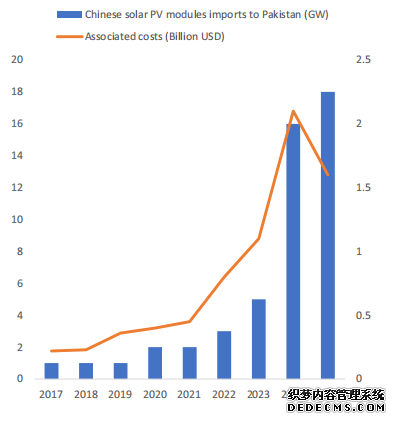
Graphic from KTrade Securities
"Affordable Chinese solar panels have expanded energy access for urban middle-class and semi-urban families, many experiencing reliable electricity for the first time. At the industrial level, lower-cost electricity from hydro and solar assets reduces production costs for SMEs and strengthens Pakistan's export competitiveness," a research by Sustainable Development Policy Institute notes.
In 2025, solar has risen from Pakistan's fifth largest power source in 2022 to its largest. By the first quarter this year, the Power Planning and Monitoring Company (PPMC) estimated that approximately 7,000 MW of net-metered solar capacity was formally connected to the national grid. More critically, a massive 13,000 to 14,000 MW of solar capacity is now operating completely off-grid, powering industrial units, agricultural tube wells, and affluent residential clusters independently of the state apparatus.
Consequently, solar generation provided over 25.3% of Pakistan's total utility electricity between January and April 2026, as per data from Pakistan's National Electric Power Regulatory Authority (NEPRA), fundamentally shielding the broader economy from the absolute worst impacts of the LNG supply collapse and the Hormuz blockade.
Initiatives formalized at the March 2026 Green CPEC Alliance conference aim to permanently transition Pakistan from a mere importer of Chinese solar modules to an integrated regional manufacturing hub. Chinese industrial behemoths, such as the Hebei Juhang Energy Technology Group, have committed to establishing vast Special Economic Zones (SEZs) in Sindh and Punjab dedicated entirely to solar PV assembly, battery storage, and BYD EV assembly plants slated for late 2026. This industrial pivot aligns with Pakistan's Nationally Determined Contributions (NDCs 3.0), which mandate a transition to 60% renewable energy by 2030 and an aggressive, binding phaseout of imported coal.
EV: Local assembly driving affordability
Pakistan's locally assembled vehicle market has rebounded strongly, growing 52% in 2024 to about 125,000 units and a further 40.5% in 2025 to around 175,700 units. "Chinese brands have been central to this recovery. Master Changan Motors sold over 65,000 units in 2025, becoming the fourth largest brand and leading Chinese player, while Sazgar Haval recorded 67.5% year-on-year growth," a research by KTrade Securities shows.
Pakistan's automotive sector has historically suffered from limited competition and relatively high vehicle prices compared to average household incomes. According to research, vehicle ownership used to remain extremely low - estimated at just 18 vehicles per 1,000 people - reflecting affordability constraints and limited market depth. "The industry also remains heavily dependent on imported components, leaving manufacturers vulnerable to exchange rate volatility and supply chain disruptions," the research noted.
Chinese automakers have played a transformative role in reshaping the sector. Through joint ventures with local partners, they invested in assembly operations, contributing to technology transfer and greater market competition. Key entrants include MG Motors (a subsidiary of SAIC Motor), Changan Automobile with Master Motors, and Haval through Sazgar Engineering. Additional participation from BAIC (with United Motors) and DFSK (with Regal Motors) has further expanded the market. These companies have introduced modern vehicle platforms, particularly in the SUV and crossover segments, offering advanced features and comfort levels previously limited in Pakistan.
From purchase to daily use,Pakistani consumers find mobility much more affordable. Changan's Oshan X7 is about 39% cheaper than comparable Japanese SUVs, and Haval's Jolion around 36% less expensive, expanding consumer choice. Meanwhile, cities like Karachi and Peshawar have introduced Chinese-made electric buses from BYD and King Long, marking early progress in EV adoption in public transport.
"Driving a petro car used to cost me nearly PKR 80,000 monthly. Now with an EV, the cost is reduced to one tenth," Khalid Mahmood said.
Building Local Talent
Beyond infrastructure and manufacturing, China–Pakistan cooperation in renewable energy is increasingly focused on human capital development and skills transfer.
Vincent Que, Overseas Opearation Manager of Tang International explained that his organization aims to train and certify nearly 10,000 skilled workers for Pakistan's EV industry over the next five years, based on Chinese technical standards.
"We have already provided short-term online training programs related to EVs and solar photovoltaics to nearly 2,000 trainees in Pakistan, with some participants seeing their salaries increase by nearly fivefold," he said.
Last year, China–Pakistan Electric Vehicle Industry-Education Integration Consortium was established, aiming to introduce China's EV technologies, vocational standards, and educational systems into Pakistan's training ecosystem while closely aligning with the talent needs of EV manufacturers operating locally.
"Pakistan is facing severe shortages of skilled labor across the renewable energy sector. These shortages range from engineers and technicians needed for large-scale solar and wind farms to workers specializing in the assembly, maintenance, and after-sales servicing of residential solar-plus-storage systems," Que said.
Working with regional partners across Pakistan, his organization plans to establish a network of "Future Competency Centers", which will serve as standardized training hubs for EV maintenance, renewable energy generation, e-commerce, and AI-related skills. Beginning this year, the initiative plans to train and certify approximately 1,000 high-level EV maintenance technicians annually.
-
 Optimus ready for mass production, humanoid robot industry c 2026-10-21
 - Asset allocation related to high volatility of international 2026-10-21
-
 UK water supply company considers importing drinking water f 2026-10-21
 - European natural gas benchmark price breaks 90 euros for the 2026-10-21
-
 US strategic crude oil reserves drop to lowest level in 44 y 2026-10-21
Related Product
Related News

- 1600 Pennsylvania Ave NW,Washington,DC20500,USA
- Telegram: @dzsms777
- Tg Group: @dzsmsPD
- WhatsApp: +1(312)3712538
Contact Us
WhatsApp: +1(312)3712538