- Telegram:@dzsms777
- WhatsApp:+1(873)7774378
Company News
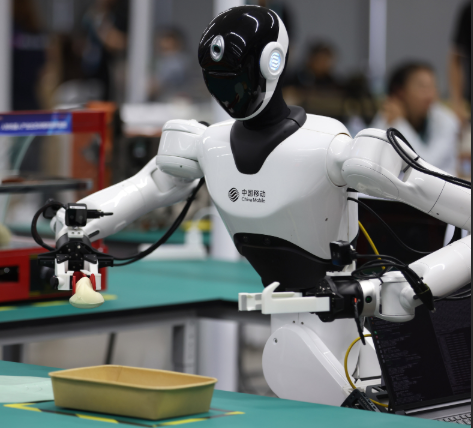
'Factory Flower' is a robot
As the labor force ages, some young people's willingness to enter the factory weakens. Nowadays, the use of embodied intelligent robots that can assemble automotive parts and complete tasks such as loading and unloading raw materials has attracted attention. In the past, the most beautiful employees in the factory were called "factory flowers", but now the "most beautiful kids" in the workshop have become robots.
The Ministry of Industry and Information Technology and the State owned Assets Supervision and Administration Commission of the State Council have jointly issued a notice to launch the annual special action of humanoid robots and embodied intelligent real-life training, and proposed to start the "operation mode" by the end of this year, "driving the formation of a large-scale landing capability of tens of thousands of units". How will this wave affect the employment system in the manufacturing industry? Half Month Talk reporters recently visited relevant enterprises in Zhejiang and interviewed industry experts to explore the real progress of robots from laboratories to workshops and the changes in future employment.
The most beautiful guy in the workshop
Entering the multi machine collaborative BMS precision assembly demonstration line of Junpu Intelligence, six G2 wheeled intelligent robots are busy on the production line in an orderly manner. Almost all 9 processes, including feeding scanning, heating riveting, visual inspection, back cover pressing, high-voltage testing, EOL final inspection, automatic labeling, scanning binding, and finished product warehousing, are taken over by these "new colleagues". The production line PLC system plays the role of global unified scheduling.
According to He Chuan, General Manager of Junpu Artificial Intelligence and Humanoid Robot Research Institute, the stability rate of the entire line merging operation of this demonstration line has reached 99.9%, and the single process cycle time is controlled within 70 seconds. It can support all-weather, full chain unmanned continuous production, "matching the high reliability and high cycle production requirements of the automotive electronics industry".
These "new colleagues" at Junpu are not isolated cases. Half month talk reporters visited multiple manufacturing companies in Zhejiang and found that the deployment density of embodied intelligent robots, collaborative robots, and AI vision inspection systems is rapidly increasing. The handling, assembly, inspection, packaging and other processes that used to require collaboration among multiple people are now being taken over by robots' packaging 'one by one.
Lou Lingtong, General Manager of Zhejiang Aitu Intelligent Technology Co., Ltd., introduced that Aitu's humanoid robot products have been deployed in several domestic clothing factories, and multiple clothing production lines are synchronously conducting on-site deployment and mass production trial operation, promoting the automation transformation of flexible processes in clothing manufacturing. The Aitu robot can successfully complete the verification of the entire operation process, including cutting separation, flexible grasping, flat material laying, and precise alignment. Under single category and single fabric conditions, the success rate of robot cutting and separation reaches 97%, and the sewing qualification rate exceeds 98%, "said Lou Lingtong.
A workshop manager from an automotive electronics company told Half Moon Talk reporters that the direct effect of robots entering the factory is stability and controllable quality, but for the company, "the most difficult thing is not to buy equipment, but to make the organization and people keep up with the equipment". Both orders and production indicate that the demand for embodied intelligent robots in industrial scenarios is real and strong, "said He Chuan.
The Change in Employment in Manufacturing Industry
Will robots' entry into factories' confiscate 'traditional workers' rice bowls? The answer is not simply 'yes' or' no '.
Taking the clothing industry as an example, the number of workers who naturally retire and leave each year far exceeds the number replaced by robots, "said Lou Lingtong." Difficulty in recruiting workers "is a common situation faced by many manufacturing factories, and humanoid robots bring structural supplements rather than job replacements.
Overall, this round of technological penetration is not simply about 'machines replacing people', but about 'job task restructuring', "said Ling Huxuan Xia, Deputy Chief Engineer of Hangzhou Zhiyuan Research Institute of China Ordnance Industry. In the context of changes in the working age population, difficulties in recruiting workers in the manufacturing industry, and increasing safety production requirements, robots are primarily used to" supplement people "and" assist people "in many scenarios, rather than completely" depersonalizing people ".
Repetitive operation positions will shrink, and on-site personnel will shift more towards monitoring, maintenance, quality analysis, process improvement, and multi equipment collaboration. Linghu Xuanxia believes that the comparative advantage of China's manufacturing industry will shift from relying solely on labor costs to engineer dividends, complete supply chains, rich scenario data, and flexible manufacturing capabilities. The logic of industrial division of labor will gradually shift from 'whose labor is cheaper' to 'who can coordinate technology, processes, and organizations faster'.
Xiong Rong, Chief Scientist of Zhejiang Humanoid Robot Innovation Center Co., Ltd. and Professor at Zhejiang University, believes that the deepening of humanoid robots in industrial applications will not only reshape the employment structure of the original manufacturing industry, but also give birth to a new high skilled occupational ecology, promoting the shift of human resources from repetitive physical positions to technical service, operation and maintenance, debugging, secondary development and other positions.
Allowing robots to perform repetitive, tedious, high-intensity, and hazardous processes, and enabling humans to perform more valuable management, technological, and innovative work - With the structural transformation of the demographic dividend, the reduction of robot costs, and the maturity of AI technology, humanoid robots will deeply participate in the future manufacturing industry. Associate Professor Wang Zhen from the School of Science and Engineering at Tianjin University of Finance and Economics believes that robots are increasingly replacing human labor in complex processes and harsh environments, thanks to the significant advancement of artificial intelligence technology.
From the current application situation, the short-term change of humanoid robots entering the factory is the practical dilemma of "unable to recruit or retain people", while in the medium and long term, it will continue to improve the efficiency and competitiveness of Chinese manufacturing. The deep involvement of humanoid robots in the manufacturing industry is by no means a simple zero sum game between humans and machines, "said Li Yin, Chief Scientist of the Hangzhou Zhiyuan Research Institute of Chinese Weapons. The process of human-machine alternation will reshape the employment map and create a new professional ecosystem.
How far is it for humanoid robots to go from being able to work to being officially employed on the factory assembly line? Industry insiders have also made cautious predictions. Lou Lingtong believes that currently humanoid robots are still in the learning stage - capable of performing single processes well, but unable to achieve full process unmanned operation. He predicts that 2026-2028 will be the validation period for the single process capability of humanoid robots, and 2028-2030 will enter the large-scale period of "multi process collaboration".
'Machine assisted humans' is the future trend
There are also some issues that need to be overcome during the process of robots entering the factory. Some companies pursue full process automation without first standardizing processes and data governance; Only calculate how much labor has been reduced, without accounting for integration, maintenance, downtime, software upgrades, and security compliance costs; Premature layoffs of skilled workers have resulted in the lack of inheritance of implicit craft knowledge. A more secure path should start from high-risk, repetitive, and labor-intensive processes, gradually verify through human-machine collaboration, and then expand the scope of unmanned operations.
The policy level is actively responding. In January 2026, the Ministry of Industry and Information Technology and eight other departments jointly issued the Implementation Opinions on the "Artificial Intelligence+Manufacturing" Special Action, promoting the "two-way empowerment" of artificial intelligence technology and manufacturing applications; In September, the Ministry of Human Resources and Social Security and other departments officially announced 11 new professions, including digital twin engineering technicians, embodied intelligent robot application technicians, and industrial product digital modelers.
The policy focus should shift from encouraging 'buying equipment' to supporting 'employment friendly intelligent transformation', "suggested Linghu Xuanxia. It is suggested to establish a monitoring and skill demand list for key industry job changes, issue timely job transfer warnings, promote vocational colleges, leading enterprises, and public training bases to jointly build short-term, modular training, and strengthen the cross disciplinary capabilities of technology, robotics, data, and safety. In addition, rules for human-machine collaboration security, algorithm application, and protection of workers' rights and interests should be improved.
The entry of robots into factories is a major trend in China's manufacturing industry towards high-end, intelligent, and green development. The wave of technology will not stop, but ensuring that every ordinary worker is not left behind and has a direction in the process of change is the joint efforts of the government, enterprises, universities, and all sectors of society. To seize opportunities in the embodied intelligence industry, it is necessary to further leverage organizational and efficiency advantages. Talent development is fundamental to industrial construction, and efforts should be made to accelerate the integration of industry and education, vocational education docking, and fill the talent gap in emerging positions such as after-sales and testing of humanoid robots.
-
 'Factory Flower' is a robot 2026-10-26
-
 How to win in "AI+"? The synergy of "green el 2026-10-26
- Youthful Chapter Pursuing Dreams in Northern Xinjiang | Sing 2026-10-26
- Damai Performance hosts Xiao Zhan's tour in Nanjing, with st 2026-10-26
- China marks anniversary of Taiwan's recovery with events ac 2026-10-26
Related Product
Related News

Sms Broadcaster Machine Telegram:@dzsms777